Challenges from two CPU Presidents

By Francis Neil G. Jalando-on
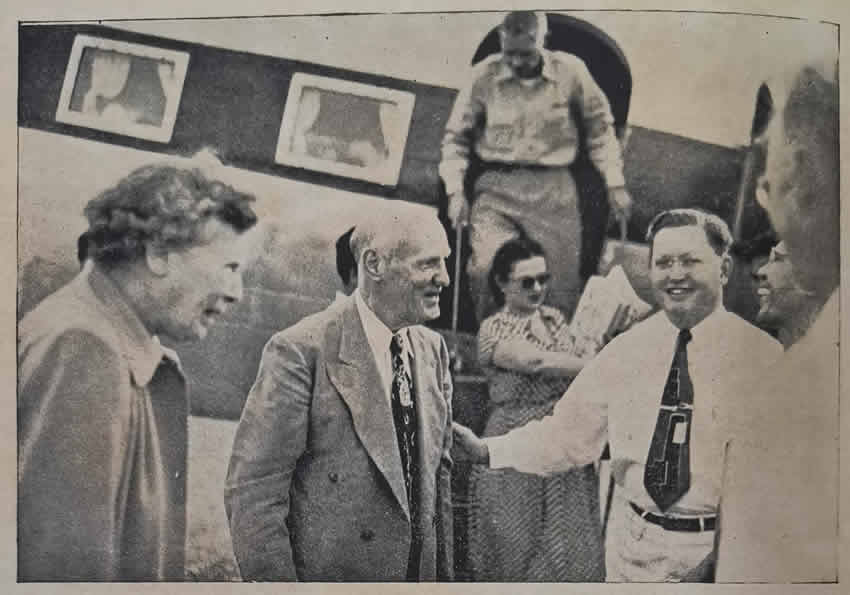
Dr. Peter Lerrigo (2nd from left) was welcomed by Centralians when he arrived at the airport. He was with Rev. William O. Valentine when they started Jaro Industrial School in 1905.

The history of Central Philippine University is rich with lessons that Centralians can learn from. Here are lessons from that we can glean from the life and ministry of two CPU Presidents: Dr. Peter H. J. Lerrigo and Dr. Almus O. Larsen.

Dr. Peter H. J. Lerrigo, a missionary doctor and President of CPU in 1950-52, posed a soul-searching question: “Did it ever occur to you that you leave behind in Central upwards of a hundred teachers and administrative workers all of whom have a stake in you? ‘In what way?’ you say. Well, you are the product of the combined impacts upon you of parents and other ancestors, friends, companions, and especially teachers. Picture, if you will, these latter: the hundred teachers you leave behind. Their faces are a mixture of pride and gloom, and just about now, they are quoting the words of attributed to the infant Father of his country, George Washington, ‘I did it with my little hatchet,’ and adding perhaps, ‘Why didn’t I make a better job of it?’”

Furthermore, Dr. Lerrigo, emphasized the freewill and personal accountability of all Centralians: “But there is one thing they (faculty and staff) didn’t do to you. They did not have the final say about how you were going to turn out. This was, is, and will be determined by choices made in your own heart, in company with that “spirit of the Divine” who lives there if you let Him. So you, yourself, and not your remote ancestors, nor your recent teachers, have the final say. And you can change the trend in any of these directions, either now, or in the future. It might be a good thing to look at your trends and see where they are likely to lead as you mingle in society. We have great faith in you. Justify it!”
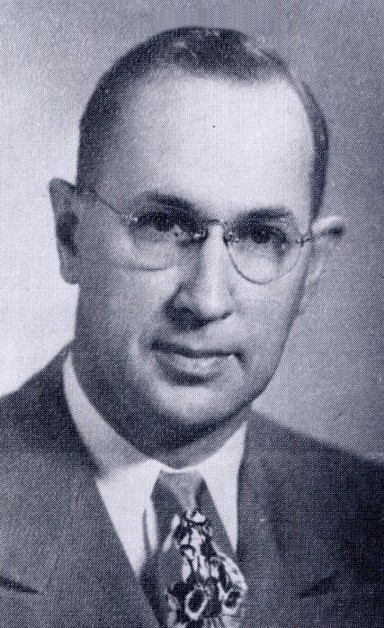
President Almus O. Larsen was passionate about raising a generation of brave Centralians by reiterating that one of the educational objectives of the school is to fight for freedom.

Dr. Lerrigo established the Capiz Emmanuel Hospital in 1902 with the money given to him by the Rockefellers who were his friends and fellow church members. Together with Rev. William O. Valentine, they started Jaro Industrial School, now CPU, in 1905. His friendship with the Rockefellers brought about another donation so that the school was able to buy the 24-hectare campus in Jaro. He was responsible for the development of the college day celebration in 1950 and of the start of Christian Emphasis Week in 1951. He is also remembered as the president when the Rose Memorial Hall, a building in honor of a Hopevale Martyr, Rev. Dr. Francis Howard Rose, was constructed

The “Central Spirit,” the bond that binds all Centralians, was explained by Dr. Lerrigo. He was in his late 70s when he became president of Central: “There is something about the Central fellowship which is not too often found elsewhere. It is a ‘something’ of straightforward and open-eyed friendship between the very young, the older youth and even the aged which means a two-way flow of life, thought, happiness, and understanding and that puts us all into the category of the wise men bringing gifts. We are free at Central. Yes, there are bonds and prohibitions, but they grow out of the nature, purpose, and atmosphere of the place. The understanding spirit accepts them as part and parcel of the Spirit which originated Central and breathes into it the breath of every day’s new life… There are occasional flaws in the fellowship and its practice. These are thrown into high relief by the uniform prevalence of the democratic spirit of give and take which emphasizes the occasional lapse.”

President Lerrigo highlighted that CPU promotes freedom and equality not just in the campus but in our country: “We are not only free but we are equal at Central; equally privileged to give and to receive, to love and be loved, and to be an articulate functioning unit in the Republic. It is a Republic of democratic spirits who for the most part, almost unconsciously, live and rejoice in the ties that bind but do not hamper.”

Dr. Almus O. Larsen, President of Central Philippine University when it celebrated its 50thanniversary, reiterated that one of the educational objectives of the school is to fight for freedom. He was trained as an educator up to his master’s degree, and then received a Doctor of Education, honoris causa.

He wrote, “We are now fifty! And mature! Mature minds can only develop where freedom of thought and of the individual conscience before God prevails. Centralians have been nourished for fifty years on a philosophy that maintains the right of every individual to religious and intellectual freedom. The right to inquire, to hear, to speak, to accept personally Jesus as Lord and Savior are not rights we hold privately but rights that we share with others. We have found it our duty, therefore, as thoughtful citizens, to protest the suppression of these freedoms wherever it may occur, knowing that if they are lost, the democratic way of life will be replaced by a fascist or communist way.”

It is good to re-examine ourselves since 1955 if we have accepted the challenge of President Larsen to stand for what gives freedom: “May we reaffirm, then, as we approach the next milestone, that the indispensable condition for the preservation and enrichment of our Christian democratic heritage is the full and free examination and exchange of ideas in all of living.”

Dr. Larsen was man of great faith and was passionate in sports. He served as a Sunday School teacher, and as president of the Association of Christian Schools and Colleges in the country. As a sportsman, he would play softball and wholeheartedly supported the sports program of the university. He was the president of the West Visayas Private School Athletics Association.

(References: Centralite 1951, 1952 and 1955)
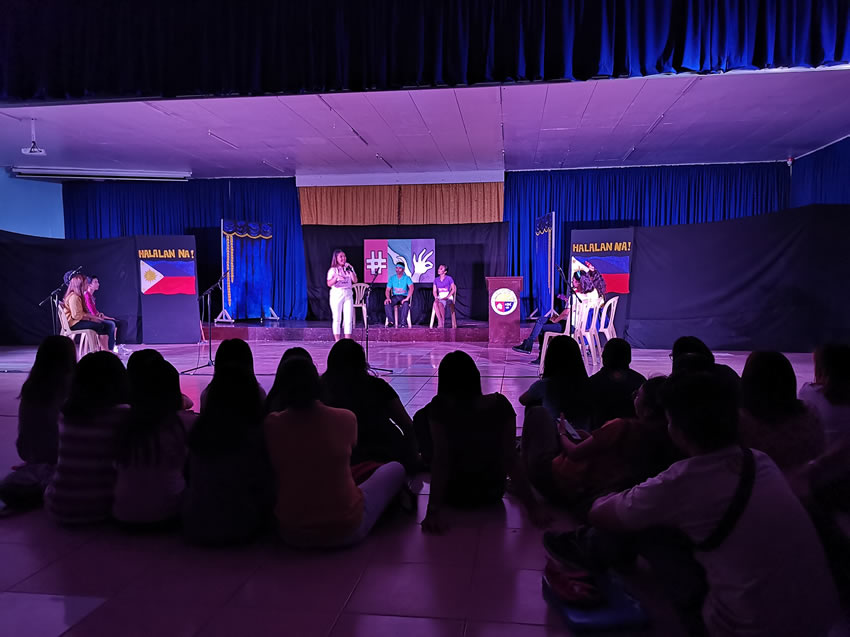
CPU Teatro, Sining, Atbp.: Advocating for awareness

By Cyrus A. Natividad

Halalan Na, Kilala Mo Na Ba Sila? encourages Centralians to be informed voters. The said production is a timely  reminder to vote wisely  in the upcoming CPUR,  local and  national election.

Even as the country waits for the National Midterm Elections in May this year, everyone in the campus is looking forward to the Student Republic (CPUR) elections 2019 next week. A play entitled Halalan Na, Kilala Mo Na Ba Sila? a production of CPU Teatro, Sining, Atbp. has raised awareness on the current political and social issues.

The story was written by Nestle G. Taala of CPU TV three years ago and was first staged on March 9, 2016 under the direction of Ms. Charity Faith Lozañes. It calls on all voters to know their candidates closely. The restaging was held on Wednesday, March 6 at 9:00 AM, 1:00 PM and 4:00 PM at the CPU EMC Conference Hall. This year’s director is Taala herself. (With reports from Nestle G. Taala, CPUTV)

The Valentine of Central Philippine University

Rev. William Orison Brown Valentine,the first principal of Jaro Industrial School.

More than 2,000 years ago, Jesus Christ challenged and commissioned his disciples to “go and make disciples of all the nations, baptizing them in the name of the Father, and of the Son, and of the Holy Spirit, teaching them to observe all things that I have commanded you; and lo, I am with you always, even to the end of the age.”

Rev. William Orison Valentine, the first principal of Jaro Industrial School, was one of the many who answered the call of God to go to the whole world and bring the Good News of Jesus Christ.

Rev. Valentine was born in Spencer, New York, in 1862, to a family of farmers and horse breeders. After taking up Normal Course at Mansfield Normal School in Pennsylvania, he taught for four years and then enrolled at the Colgate Theological Seminary.

After completing his studies, he joined the American Baptist Foreign Mission Society and was sent to Burma, first to Rangoon in 1895, then to Mandalay where he became principal of the Baptist Mission High School for Boys. In his eighth year in Burma he suffered from severe sunstroke and returned to America for treatment. It was during his treatment that he met his wife, nurse Ina Jane Van Allen.

The couple was married in 1903 and soon left for their new appointment in Iloilo City.

Before the Valentines arrived in the Philippines, the Baptist mission had already started. In May 1900, Rev. Dr. Eric Lund, a Swedish Baptist missionary, and his newly baptized convert, Braulio Manikan, a native of Aklan, arrived from Barcelona, Spain. The two soon started the ministry of preaching, teaching, and healing while continuing to translate the whole Bible into Hiligaynon.

The preaching ministry resulted to organizing churches in Iloilo, Negros, and Capiz. For instance, Jaro Evangelical Church was organized in September 1900[a], Bacolod Evangelical Church in 1902, and Capiz Evangelical Church in 1908[b]. As to the healing ministry, the Philippine Baptist mission established two hospitals in Panay Island, the Iloilo Mission Hospital in 1901, and the Capiz Emmanuel Hospital in 1908. The teaching ministry resulted to the establishment of a Baptist Home School in Capiz in 1904, now known as the Filamer Christian College. In Iloilo, Anna V. Johnson also opened the Baptist Missionary Training School. The following year, in 1905, Rev. William O. Valentine, became the principal of two newly-opened schools, the Bible School for men, and the Jaro Industrial School.

Jaro Industrial School started as an Elementary Vocational School for boys who worked for their board and tuition. The first batch consisted of 20 boys. It was the first school in the Philippines to teach that labor is honor. Rev. Valentine recounted that, “it was decided that in this new school, no boy, no matter how rich, should be admitted who was not willing to work for his food… All must work for their food.”[c]

“The original purpose of the school was to provide opportunity for poor Filipino boys to receive a good Christian, industrial education by working their way through school. Actual work experience and earnest study of the Bible were the core of the curriculum.”[d]

The school also had the distinction of having organized the first student government in the country—the Jaro Industrial School Republic now, the CPUR Republic. Rev. Valentine modeled the student republic on the American civil government. In the words of one of the first graduates, “The Jaro Industrial School Republic takes a boy, nurture him in the atmosphere of genuineness, originality and individuality, until he discovers his real self; leads and encourages him in his struggle for existence—in his struggle against poverty, the seemingly insurmountable barrier to get an education; trains him for citizenship; lets him taste the joys of Christian life by having him live that way for years; and then turns him loose into the world, a Christian man.”[e] CPUR and campus politics have honed many leaders. These student leaders eventually became successful leaders in society.

By 1907, the enrolment of the school grew. There were now 300 boys working in the farm and in various trades. Rev. and Mrs. Valentine by this time were very busy in school affairs. Mrs. Ina Jane Valentine taught some subjects and at the same time cared for the three Valentine children born in Iloilo between 1904 and 1913.

Rev. Valentine worked hard to have the school incorporated and recognized by the government. His objectives were reached in 1913, the year when the school began to admit female students. In 1915, the first two years of high school were opened and by 1921, the first batch co-ed high school graduated.

In 1914, Valentine returned to America with his family to further his studies. He studied at Valparaiso University, where he received his Bachelor of Arts degree, and at the University of Chicago, where he presented a master’s thesis in the department of practical theology. His thesis entitled “Moral and Religious Values of Industrial Education,” recounted the success of work-study schooling at Jaro and other schools in Burma, South Africa, and India which had developed a similar philosophy of institutional self-support through the work of students. He earned his Bachelor of Divinity and Master of Arts from the University of Chicago.

With the completion of his studies in 1916, Valentine received a new appointment as Provincial Missionary for Negros Occidental, Philippines. He and his family went to Bacolod and became the pastor of Bacolod Evangelical Church.

He was instrumental in building a new mission house to replace the smaller chapel and encouraged Filipino Baptist pastors to preach at Sunday services. He also established dormitories for boys and girls who attended public schools. These students received a Christian education at the mission house.

Because of his passion for Christian education, Rev. Valentine set about not only to establish new churches but also private schools in Bacolod and throughout the province like the Ilog Private Academy in the southern part of Negros Occidental. Mrs. Valentine taught kindergarten in the Bacolod school. The school and the church grew in quality and quantity during the 11 years that Rev. Valentine served there.

In February 1928, tragedy struck not only the Valentines but also the blossoming mission work. Rev. Valentine died in Bacolod of malaria complicated by a heart disease. He was buried at the American Cemetery in Jaro, Iloilo City. Mrs. Valentine returned to America, and bought a home offered by the Baptist Mission Society in Granville, Ohio, across the street from Denison University where all three Valentine children studied. She died in 1979 in the age of 100.

Soon after Rev. Valentine died, the Negros Kasapulanan of Baptist Churches and the Bacolod Evangelical Church renamed the mission house in Bacolod as the Valentine Hall. In this Valentine Hall, two Baptist institutions were born. In 1948, Baptist leaders in Negros met and decided to establish a college to be housed in the Valentine Hall. This college was named as the West Negros College, now West Negros University. In 1950, the Bible Institute under Department of Christian Education of the West Negros College became a separate institution and was renamed as the Valentine Memorial Academy. This Bible School is now known as the Convention Baptist Bible College.

The Lord indeed works in mysterious ways. Even though Rev. Valentine died, his legacy lives on and gave birth to two successful learning institutions in Bacolod City.

Back in Iloilo, the Central Philippine College also decided to rename the then Administration Building as Valentine Hall, in honor of its first principal. Later, when the annex building was completed near the Valentine Hall, it was appropriately called the New Valentine Building. Soon after, a new tradition was started. Every Foundation Day in October, University officials come to the American Cemetery to lay a wreath of flowers on the tomb of Rev. Valentine and other American missionaries.

In 1969 CPU conferred a posthumous doctoral degree upon Rev. Valentine. He was accorded a Doctor of Pedagogy, Honoris Causa.

When CPU celebrated its 100 years on Oct. 1, 2005, a Bronze bust of Rev. Dr. William O. Valentine was unveiled during the Foundation Day ceremony to honor the life and ministry of the first principal of CPU.

More than a hundred years ago, Rev. Valentine witnessed how God was faithful in the humble beginning of Central Philippine University. With just 20 boys working for their tuition and food, Rev. Valentine gave his full commitment. Now, we are witnesses to the legacy of Rev. Valentine and other American Baptist missionaries. God was faithful then and God continues to be faithful until now. CPU is now home to more than 12,000 students, and more than 700 faculty and staff. CPU has also maintained the coveted Autonomous Status granted by the Commission on Higher Education since October 2001.

Thank you, Rev. Dr. William Orison Valentine, for giving your whole life to the Filipinos and to the Centralians. May we continue your legacy of sacrificial commitment in serving God and his people. To God be the glory!


[a] Nestor D. Bunda, A Mission History of the Philippine Baptist Churches 1898-1998, (1999) p. 164

[b] Henry W. Munger, “Baptists in the Philippines” in The Chronicle, Vol. 1 No. 4, (October 1938) p. 171

[c] William O. Valentine (1916) p.22

[d] Linnea A. Nelson and Elma S. Herradura (1981) p. 8

[e] The Hoe(December, 1913)

Centralians at Iloilo Mission Hospital

Aloha and her Centralian Assistant, Ash Duma-an.

It is understandable why Centralians or graduates of Central Philippine University are leading the number of employees at the Iloilo Mission Hospital (IMH).  Historically, IMH is a sister institution of CPU, both being founded by American missionaries with other Christian institutions in the early 1900’s. Moreover, Iloilo Mission Hospital is an extension school of the CPU College of Nursing. Nurses, medical assistants, and medical technologists are trained at IMH prior to their graduation in college; thus, they are given priority during employment.

However, Centralians in the medical field and working in IMH are not acknowledged solely for these facts. Centralians are a valuable part of hospital service and courtesy, and these are largely attributed by both patients and the staff to the Central Spirit.

For Aloha Cocjin Genovaña, CPU Med Tech ‘93 and Ms. CPU Alumni 2013, Central spirit “is the spirit of humanism and love of service. Our daily work in the hospital is inspired by the Central spirit. Care is central in our mission to provide quality service to our patients. Putting our best in the workplace is also central in our duties at the IMH.”

Aloha Cocjin Genovaña on duty.
Mae Therese and her Centralian co-worker William Jinon.
Mae Therese on duty at the IMH.

Mae Therese Simpas, CPU High School Batch 1986 and BSMT Batch 1991 is proud of her being a Centralian worker at Iloilo Mission Hospital. Accommodating patients and providing for their needs involve kindness and are motivated by the values she learned from Central Philippine University.

Next time you are at Iloilo Mission Hospital, find the CPU pin on the nurses’, doctors’, and medical technologists’ uniforms and start expecting the quality service inspired by the Central Spirit.