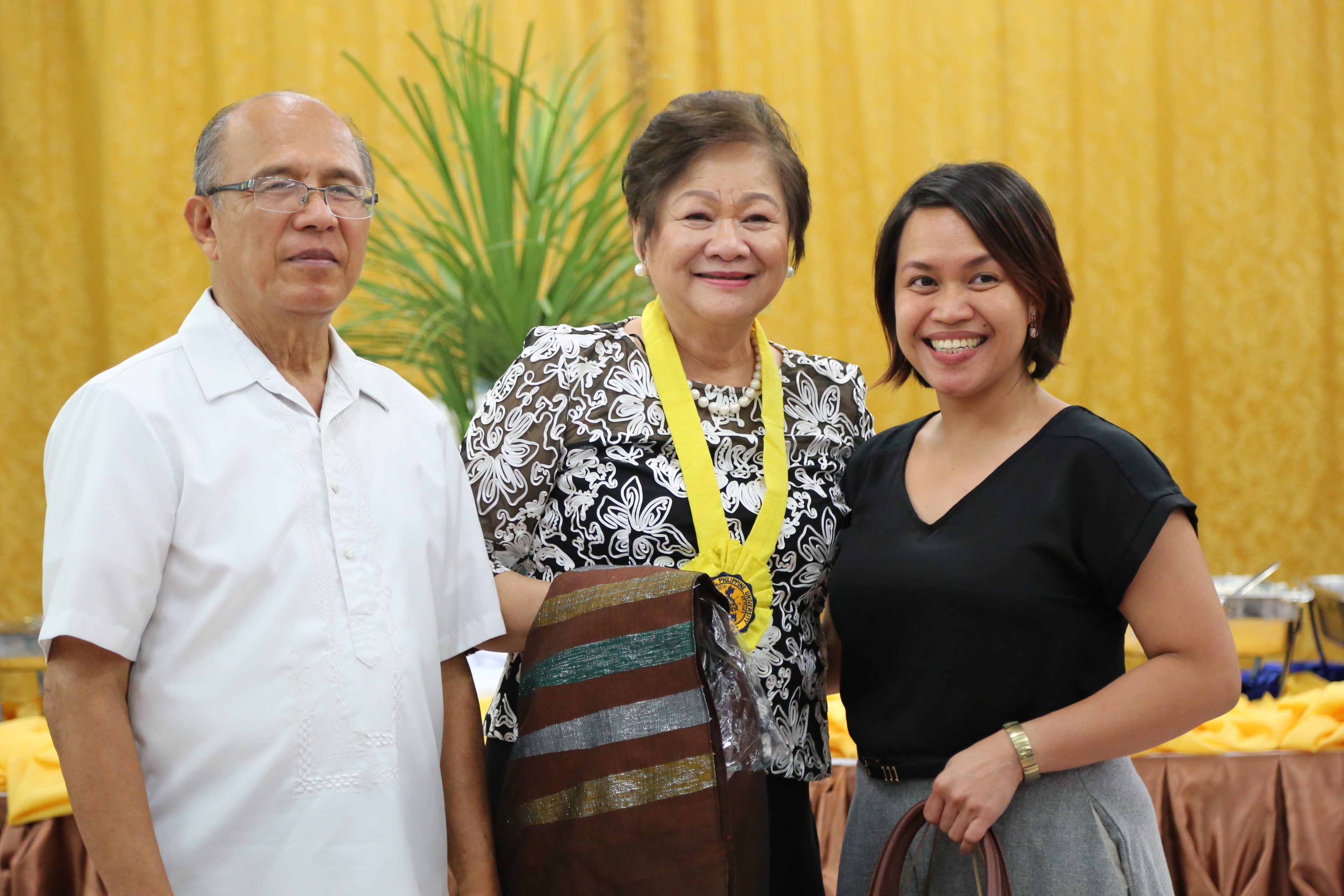
Dr. Leonor M. Briones was the keynote speaker during the 57th ACSCU Annual convention in Cagayan de Oro City. In photo: Dr. Leonor M. Briones together with CPU President, Dr. Teodoro C. Robles, Dean, CPU College of Theology Rev. Bernabe Pagara, Prof. Anna Mae Zerrudo, OIC, CPU International Programs and Prof. Kay Arden Gallo.
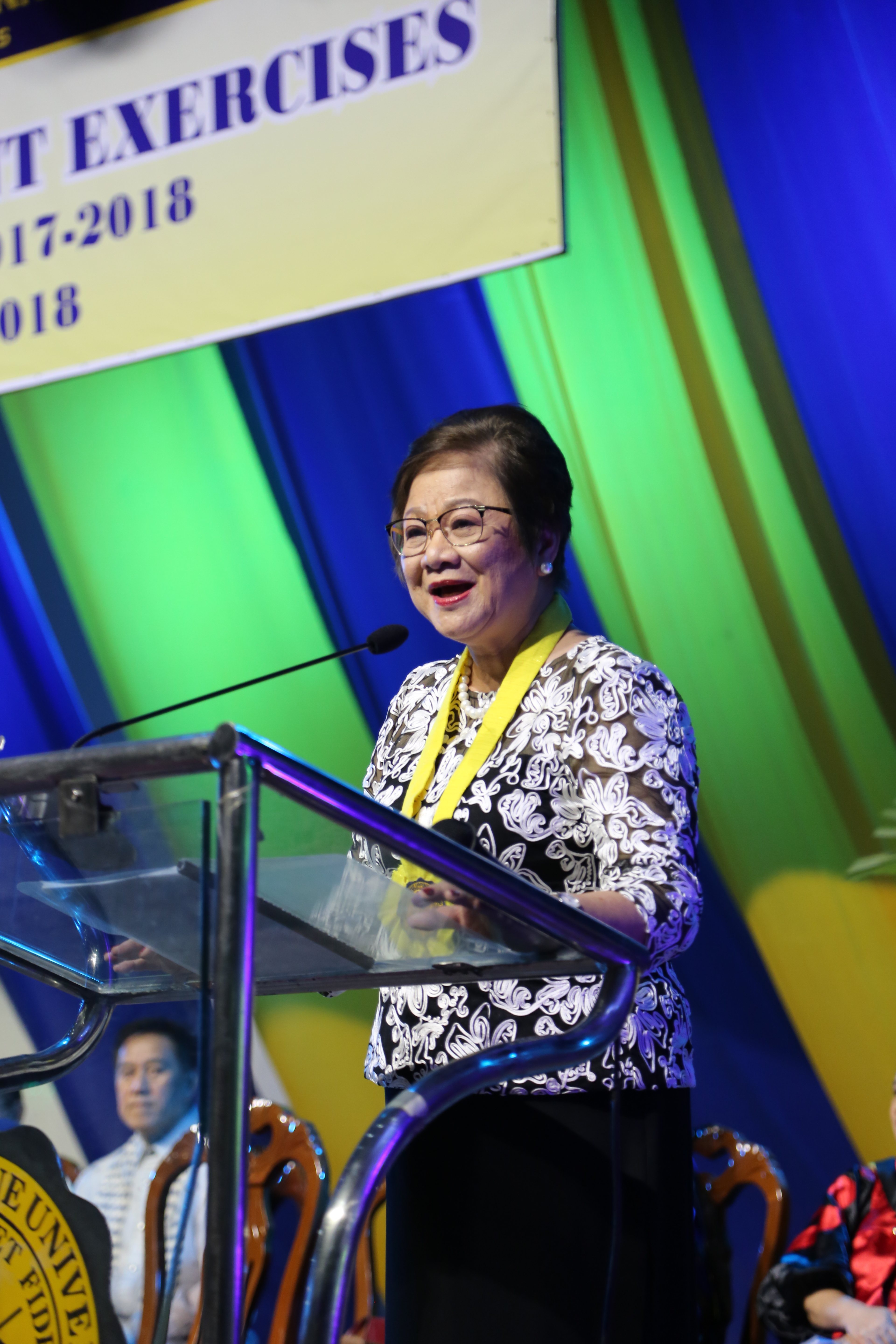
Dr. Leonor Magtolis Briones is the keynote speaker at the Association of Christian Schools, Colleges and Universities (ACSCU) convention in Cagayan De Oro City on May 15, 2018. The ACSCU regularly gather to support each other and to discuss problems in education.
Briones recognized the roles of Christian Schools in Philippine Education, stating that church-instituted schools were established a lot earlier than public schools. She went on to explain that it is the faith of people that have made them to set up schools and they recognized this as part of their faithfulness to God. The early missions of foreigners contributed much to the institution of schools and universities.
She reminded participants who are stakeholders and administrators of the colleges and universities not to be competitors but to unite to face the challenges in Christian Schools. She added, “Public and private schools should be complementary.”
In particular, Briones confronted issues in the development of K-12. As former Chairman of the Board of Trustees of Silliman University, Briones recalled how she saw a staggering loss of income of 40 million in a small university and yet considered how important the K-12 program is to the educational development in the country. Briones likened the existence with K-12 to the biblical story of Joseph who predicted a seven years of prosperity and seven years of suffering; only, it would be the reverse with K-12. She acknowledged the free tuition fee program in universities and colleges was implemented as a result of the five years of sacrifice in implementing the K-12 program.
Furthermore, she urged teachers that “what we teach in schools should be the truth. To be free, we need to teach teachers to seek the truth.” Adding, “Seek ye the truth and the truth shall make you free.”
Dr. Briones is a woman of faith and public service. She is Secretary of the Department of Education and honorary Centralian conferred with the Doctorate Degree in Public Administration, honoris causa by Central Philippine University. She obtained her Bachelor in Business Administration Degree, magna cum laude, from Silliman University and Masters in Public Administration degree from the University of the Philippines-Diliman, College Honors awardee. She obtained her post-graduate diploma in Development Administration, Major in Public Enterprises, with distinction,from Leeds University in England, United Kingdom; Certificate in Policy for Public Enterprise from the Harvard Institute for Institution Development, Harvard University, Massachussetts, USA; and Certificate for Innovations in Governance from the John F. Kennedy School of Government, Harvard University.
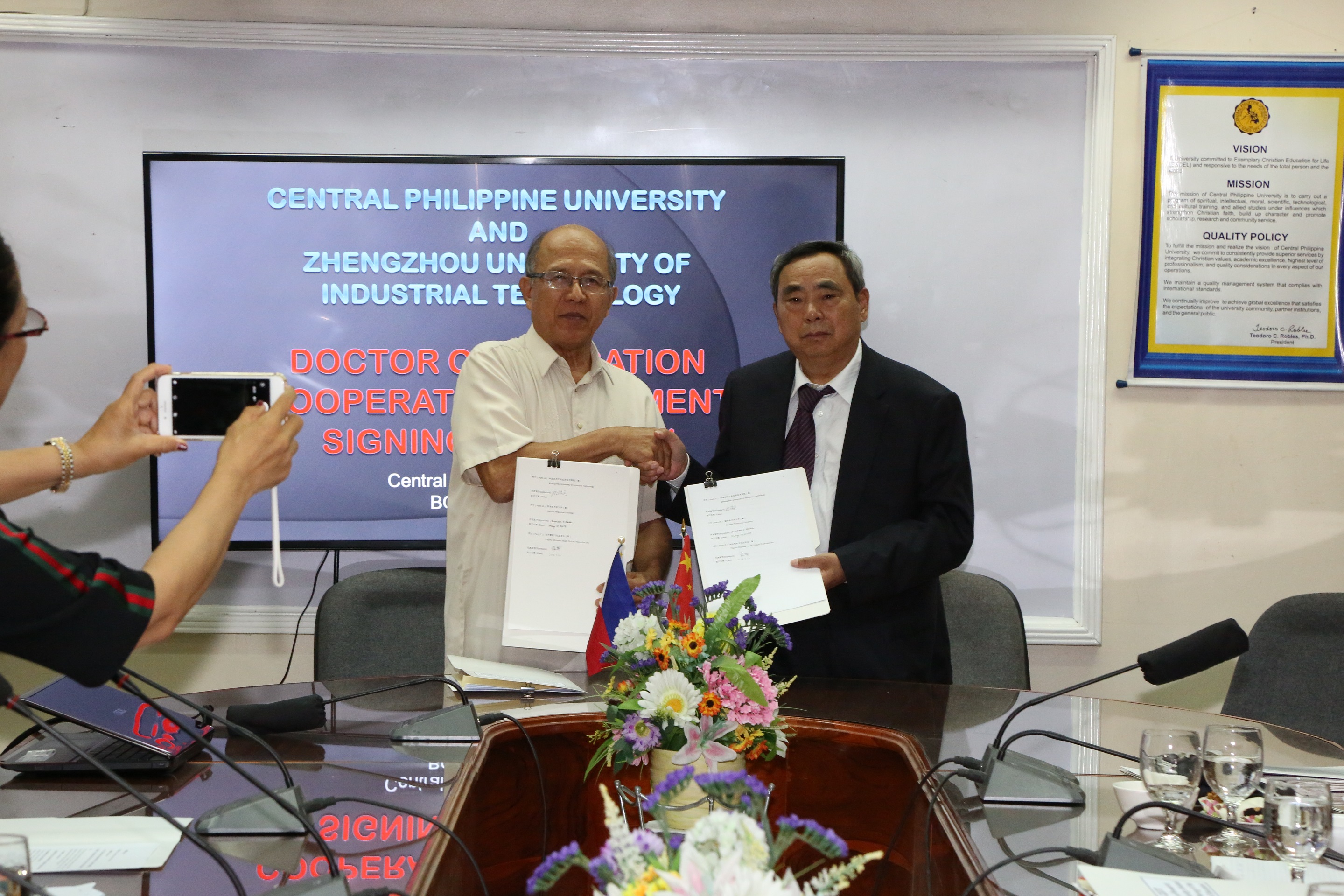
Building new heights for educational exchanges – CPU President, Dr. Teodoro C. Robles and ZZUIT President Dr. Yao Xiyuan officially signs the Cooperative Agreement.
Strengthening educational ties—Central Philippine University and ZhengZhou University of Industrial Technology signed a Doctor of Education Cooperative Agreement at the Administration Building, Board of Trustees Conference Room on May 10, 2018.
In his welcome remarks, CPU President, Dr. Teodoro C. Robles highlighted the strong ties of the university to educational institutions all over the globe. “CPU has been at the forefront of linking with many universities not only in the ASEAN Region but with other countries as well such as China, Japan, and Korea. With this academic linkage that we will establish today, we aim to improve our knowledge of the culture of China and to partner together in the development and progress of our respective institutions. We aim to improve not only our relationship with the university but with the people of China as well.”
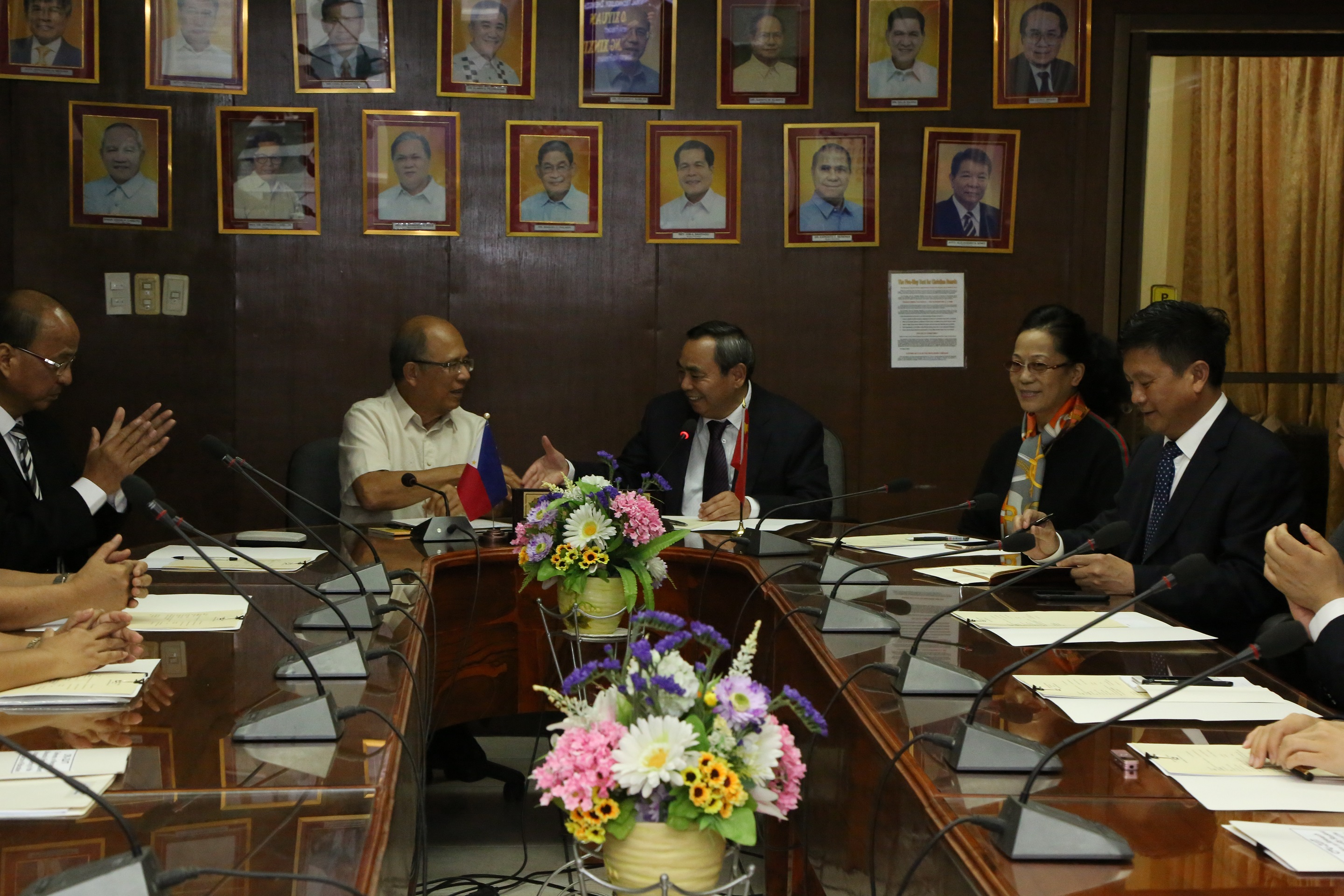
The start of a wonderful beginning – CPU and ZZUIT discussed possible joint degree programs, faculty and student exchanges, and collaborative research.
After his message, Dr. Robles introduced the CPU officials present for the signing, namely, Rev. Joniel Howard H. Gico, Vice President for Student Affairs; Dr. Irving Domingo L. Rio, Vice President for Academic Affairs; Dr. Florence P. Bogacia, Vice President for Finance and Administration; Prof. Rowena M. Libo-on, Director of the CPU Transnational Programs; Prof. Anna Mae Zerrudo, OIC of the Office of International Relations and Cooperation; Rev. Francis Neil G. Jalando-on, Director of the CPU Office of Communications; and Dr. Merle Junsay, Dean, CPU College of Education.
In reply to Dr. Robles’ message, Dr. Yao Xiyuan, ZZUIT President, expressed his gratitude for the warm welcome of the CPU Administration. “In this beautiful month of April, we have come to a very beautiful Philippine university, CPU. We are received very warmly and we are thankful for the wonderful accommodation.”
Dr. Yao then introduced the ZZUIT officials who accompanied him, namely, Prof. Yang XinXin, University Vice President; Prof. Feng GuangHui, Director of the Human Resource Department; Dr. Cen ShiHong, Director of Scientific Research Development; Prof. Wang HongHai, Director of the Office of the University President; and Prof. Xue XueHui, Director of the Board of Governors.
Both universities discussed possibilities on joint degree programs, faculty and student exchanges, and collaborative research. The said agreement will carry out joint postgraduate training program for the degree Doctor of Education, Major in Administration and Supervision. It is expected that the cooperation will cultivate a high level of understanding and enhance the intellectual capability to promote economic and social development.
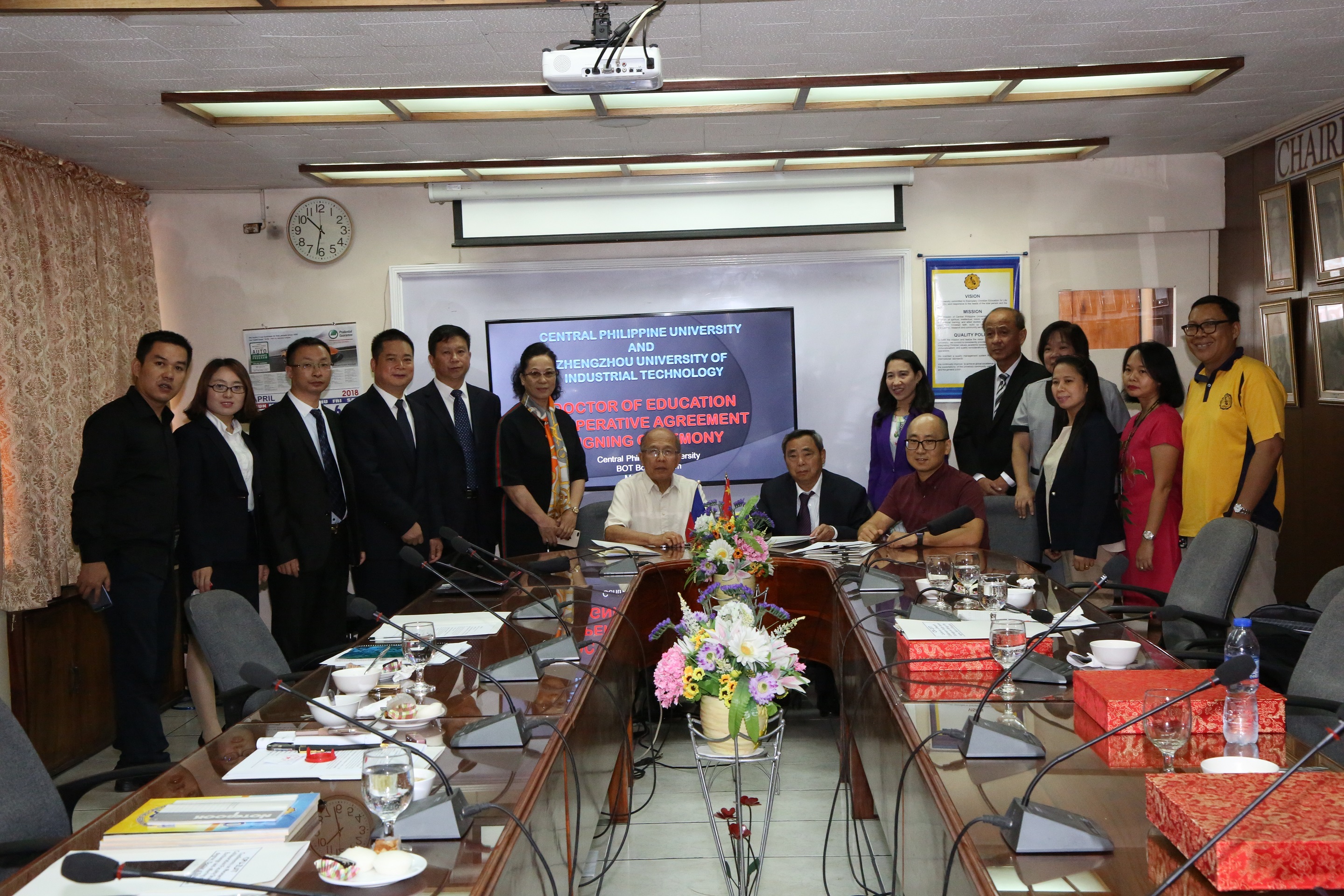
CPU President, Dr. Teodoro C. Robles and ZZUIT President Dr. Yao Xiyuan together with the university officials of CPU and ZZUIT.
It should be noted that both universities have held various programs and visits to strengthen their academic ties. On June 4-7, 2017, Dr. Robles together with his wife, Mrs. Angel Robles, Dr. Rio, and Prof. Yap-Zerrudo were treated to an educational tour of the facilities, laboratories, and equipment of this university located at ZhengZhuo City, Henan Province, China. Dr. Robles was honored to speak before the graduating students as the Commencement Speaker for graduation exercises in the said university.
On August 4, 2017, the Review Continuing Education and Consultancy Center in cooperation with the Office of International Relations and Cooperation held a one-day seminar on Chinese History and Culture entitled “The Charm of Central China” featuring the faculty of ZhengZhou University of Industrial Technology as expert lecturers.
On October 17-30, 2017, Engr. Dany C. Molina, Dean, CPU College of Engineering; Engr. Jeriel G. Militar, Chairperson of the CPU Mechanical Engineering Department; and Engr. Alejandro R. Manderico, faculty, CPU Mechanical Engineering Department went to ZZUIT for an immersion. The said visit enabled CPU faculty to observe the methods and applications of teaching and classroom and laboratory management of ZZUIT.
The partnership between CPU and ZZUIT was made possible by the Filipino Chinese Youth Culture Promotion, Inc. (FCYCP) co-founded by Mr. Xiu Bin and Mr. Yao-Yong Zeng. The group aims to establish mutual connections between the Philippines and China through youth education and exchange.
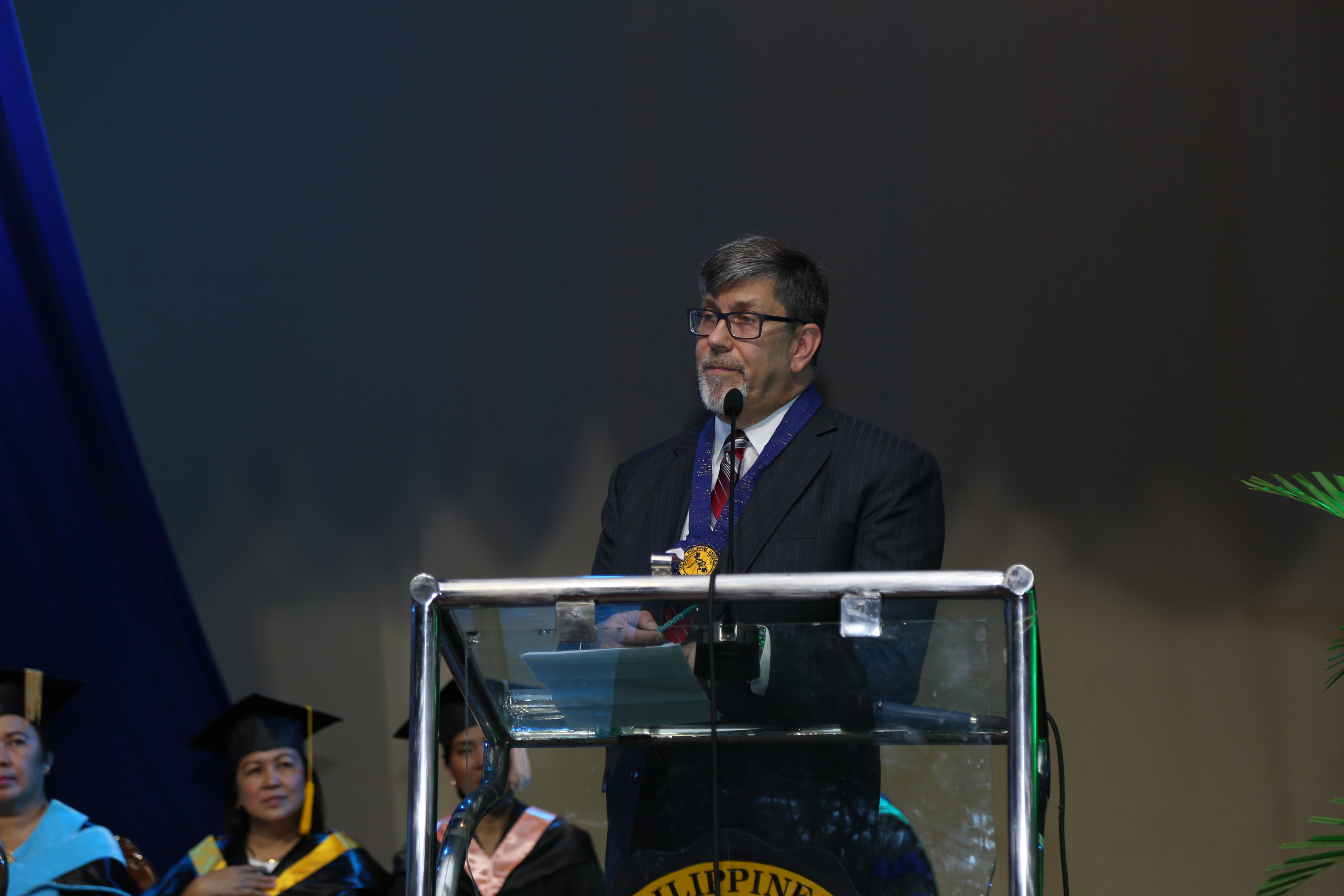
Guest Speaker Mr. Ronald Zack inspires the graduates with his testimony.
Good Afternoon graduates, parents, families, Dr. Robles, members of the CPU Corporation and Board of Trustees, administrators, faculty, and staff. Congratulations to all the graduates, and to your parents who made it possible, and even, in many cases, to your older siblings and other family members. Thank you for the honor of inviting me to speak here at Central Philippine University, a world class university. I also want to specially thank President Robles and my wife for introducing me to, and welcoming me into, the amazing CPU family. Next year, my wife, whose maiden name is Erlinda Villanueva Arlos, will be celebrating the 50th anniversary of her 1969 CPU nursing class graduation. Over the 38 years of our marriage, I have met many of her classmates. I+ve been so impressed how the women and men of that class of 1969 have remained so close all these years, being separated by miles around the world. Many of her classmates have lived and worked in the Philippines, United States, Germany, Australia, Saudi Arabia, and other countries. Despite the distance, they remain close to this day—a testament to CPU and the strong bond among alumni.
On a personal note, a more selfish note, had it not been for CPU, Erlinda may not have gone to the US as a nurse, and I may not have met my best friend and the love of my life. Salamat Gid, CPU.
I am going to speak to you, in a few minutes, about three major principles that will guide your planning for your life, and I want to remind you, Graduates, that your education is just beginning. While your current accomplishment is great, you have only scratched the surface of your education. You will and you must, keep learning.
When I told a friend I had been invited to speak at the university+s commencement exercises, he said, “Why? Why you?” I asked, “What do you mean?” And he told me, “Well, for one, you+re a high school drop out.” That+s true. I thought about it. Why me? And I thought, “Of course, me. Because I am a high school drop out. It may be different in the Philippines, but in the United States, I was able to get another chance—several chances thanks to my parents and to my faith in God. While I did drop out of high school, I was still able to go on to college. And then, I actually dropped out of a few colleges, too. In fact, I have completed, and incompleted, credit courses at 19 different colleges and universities. Going to college became a lifelong occupation that, so far, has resulted in five college degrees. It can be done. And if I can do it, anyone can do it.
I received my first degree, in nursing, at the age of 22—probably close to the age of a lot of you. At 29, I received my bachelor+s degree in Health Occupations and English. At 38, I was awarded my first master+s degree—a Masters in Linguistics. My master+s thesis, by the way, dealt with research regarding some grammatical elements of Hilagaynon-Ilonggo. But please, don+t try to speak to me in Ilonggo. I won+t understand. At 49, I obtained a Juris Doctorate, my law degree. At 59, I achieved my Masters in Nursing Education.
Over the years, I+ve had a few careers: In nursing and teaching, in insurance and real estate and in law.
I have also owned businesses. I have viewed all these careers as service occupations and I believe that anything we do, should ultimately be done to serve God through serving others. In all my careers and occupations, I have experienced successes and failures. I value my failures far more than my successes—I+ll tell you why in a bit. My point is that I+ve studied many subjects and tried many different careers.
Sometimes that+s what it takes to find the path you will eventually follow. Sometimes that+s what it takes to find the path God wants you to follow. And sometimes, that is the path God wants you to follow. And I believe nothing I’ve ever studied and nothing I’ve ever done as an occupation has been wasted. It all has some application to what I am doing now and what I will do in the future.
Currently, and for the past many years, I have been focused on two careers—nursing and law. I have been able to combine these in a unique way. In each area, I deal with what are often called end-of-life issues. As a lawyer, I specialize in estates and trusts. I often say, I help people plan for disability and death. As a nurse, I often work with the geriatric population (with older people), and also in hospice. Hospice, in the United States is a medical program providing additional services and comfort care to terminally ill patients. So, in nursing, as well as in law, I am helping with issues related to disability and death.
While it may sound like I am focused on the negative, my message is a positive one: what I am really focusing on is life—living. But in planning for life, we must keep the end in mind. The motivational speaker, writer, and coach, Stephen Covey, wrote a book called the Seven Habits of Highly Effective People. The second of those seven habits is to begin with the end in mind. Begin with the end in mind. In my interpretation, we must begin with the ultimate end in mind. So we all need to realize we are only here for a limited time. Don+t waste it. There is nothing more precious than time.
The Filipino-American author, Cecilia Manguerra Brainard wrote a beautiful novel called Magdalena about three generations of women in Cebu. In one passage from her novel, the protagonist reflected, and I quote: “One day soon, this body will be old; and not too long afterwards, it will turn to dust. This thought frightened her, made her think how insignificant she was, made her realize that she alone can give her life significance.” End of quote. In this passage, she offers us the lesson that you can all be significant. Your lives can and will be greatly significant. But you are responsible for making that happen—and, with God+s help, you+re going to do it.
When I talk to people about planning I talk about three major principles that should guide them in planning and living. Those are: 1) Everybody is different; 2) Things change; and 3) Keeping the ultimate end in mind, everyone dies.
Now, the first principle—everyone is different. Very important. And this is why you alone can give your life significance. While it is important to have role models and mentors and many productive relationships, it is equally important that you accentuate and celebrate your individuality. You cannot rely on someone else to give your life significance. Your plan is different from everyone else’s. God’s plan for you is different from his plan for everyone else. Don’t be afraid to assert that difference. Don’t be afraid to let your differences shine through. Unfortunately, many people try to gain significance through imitation and mimicry. That doesn’t work. Each one of us is better than that.
In my lawyer life, I use this principle, that everyone is different, to demonstrate why everyone needs an individualized estate plan. The estate plan consists of a number of documents like a will, trust, powers of attorney—a list of instructions for how that person wants to be treated if they become disabled, and how they want their property distributed after they are gone. I tell my clients, there is no one size fits all plan. One of my colleagues says, you can buy a one size fits all bathing suit. But someone will be embarrassed. Just look around you.
There is no one size fits all plan for life. Be you. Your individual significance will come through service to God and service to others in your own unique way. But remember too, the gratitude owed to those who made this possible for you. Your parents, older siblings, other relatives, teachers, and friends who encouraged you and helped with your education.
The second major principle, things change, is just as important as the first. You will often create plans that will change. Some will end in failure—I’ve had many of those. The only way to not ever fail is to do nothing. Failure forces us to grow. I used to do a lot of criminal appeals—taking criminal cases, in which my client was found guilty—and asking a higher court to reconsider that decision. These kinds of cases have a very low rate of success. The reason for that is that the vast majority of criminal defendants did what they were accused of and if they were convicted (found guilty) in a court trial. There was probably evidence to prove it. But under the law, they are entitled to an appeal to a higher court—for a second chance. And a few appeals are successful. I would tell my clients, often speaking to them through plexiglass in a prison visitation area, that their likelihood of success—of prevailing in an appeal—was extremely low. Often less than 3-5%. Sometimes they would ask, “Then why bother?” I would tell them that although there was only a small chance of succeeding if we try, if they didn’t try, they had a 0% chance of prevailing. And you never know. If you succeed, you are that much ahead. If you fail after trying, you probably just remain in the same place.
When I was considering at the age of 47 to go to law school, I was being encouraged by Kevin, a doctor and a dear friend of mine. I was looking for excuses not to go. Arguing against law school, I told Kevin that by the time I finished my 3 or 4 years of law school, took the bar, and became a lawyer, I would be over 50. Kevin said, “But, Ron, if you don’t go to law school, you will still be over 50 in 3 or 4 years and not a lawyer.”
So don’t worry if your plans have to be re-drawn. When I first graduated from college as a nurse at 22, I never would have thought I would someday be a lawyer. Things change. I never planned on having all daughters. I never foresaw the path I now find myself on. And I have always been a very goal-oriented person—the kind who writes down their goals, monitors the progress, checks them off, and reevaluates. But we must be flexible and resilient. One of my professors when I studied education said that in teaching you always had to monitor and adjust, monitor and adjust. The only constant in education, he said, the only thing that never changes, is the fact that things will always change. And that is how life is. Don’t become so entrenched in doing things one way, remaining on one path. Embrace change. Be prepared to reinvent yourself. Be prepared to fail and to start over. It is the way to grow and succeed and certainly the way you give your life significance.
The third major principle in planning is everyone dies. Not a happy thought. The American comedian Woody Allen says, I am not afraid of death, I just don’t want to be there when it happens.
Some people accuse me of being obsessed with death. Early in my nursing career when I worked in intensive care and emergency departments, I witnessed a lot of people die. I was profoundly impacted by those deaths and I think it was one of the things that has caused me to value my time so much. And it has also given me a sense of urgency, a need to accomplish and a need to serve. Another experience had an even stronger impact on me. In 1990, at the age of 37, I was diagnosed with lung cancer. At that time, that type of cancer, adenocarcinoma of the lung, had a 5% five-year survival rate. In other words, when I was 37, the likelihood I would have lived to age 42 was very low—5%. Like winning a criminal appeal. Fortunately, the cancer was caught very early, the treatment was effective, and my prayers were answered. Twenty-six years later I am still alive. And that experience served to change my perception of a lot of things. And since that time, every second is so precious to me. But you don’t need a near death experience to realize how precious time is. Steve Jobs, the founder of the Apple Corporation, said, “If you live each day as if it were your last, some day you will most certainly be right.” For Steve Jobs, that day came when he was just 56 years old.
My point in beginning with this ultimate end in mind is not to be morbid, but to drive home the fact that our time is so limited. We don’t know when our time will end. And we can’t change the past. We only have control over the present. And we have to use the present to make our future. There is so much wonder and excitement in the world. So much beautiful variety. So many things available to us, so much that we can accomplish. So much good we can do. We will be much more successful, fulfilled, happy, and significant keeping the ultimate end in mind, using time wisely and treating time with the deep respect it deserves.
Again, the 3 major principles in planning:
1) Everyone is different.
2) Things change.
3) Everybody dies—time is precious.
Again, thank you so much for the opportunity to be with you on this special day. I wish you all a beautiful future. God bless you all.
Ms. Perla Londres Guillergan Waters together with CPU President, Dr. Teodoro C. Robles and Ms. Carmelle Frances Romero.
Chairman of the University’s Board of Trustees Atty. Von Bedona, University President Dr. Teodoro Robles, Past Presidents Dr. Juanito Acanto and Dr. Agustin Pulido, Deans of Colleges, CPU Registrar Ruth G. Fernandez, CPUAAI President Engineer Isagani Jalbuena, Members of the Board of Trustees and the CPU Corporation, Faculty and Staff, Parents, Families, CPU community, Fellow Alumni, Honored Guests and especially, the 2018 Graduating Class of the Colleges, good afternoon.
I am honored to be given this opportunity to be with you today. When I received this kind invitation in February, I couldn’t help but wax nostalgic recalling my growing up years in this community that I love. I grew up in a humble home on North Road, with just a fence separating our house from the mainstream of CPU’s activity. That house is gone—in its place is a big boarding house, but the gate that allowed us private access to the campus remains.
And what an access that was—a gateway to friendships and shared playtime, study time and growing up times; a portal to learning and extra-curricular activities to round up our schooling; a path to Christian teaching and example, leading to our baptism and membership in God’s family; and an opening to a community who, along with our parents, exhibited an interest in our upbringing by extending nurturing support with discipline and love, so we can become the people we are today.
I never thought I would have an opportunity to stand on this stage, one where one of my most favorite people in the world—Dr. Evangelica Padernilla—stood, just a few months ago, a stage that is symbolic of other stages in the past where people I look up to and esteem, have stood. I am humbled that my dear friend, our President, Dr. Teodoro Robles, and the Board of Trustees have found me worthy for this singular honor.
Hence, I am here today, my second trip to CPU this year, equipped with prayers and encouragement from many, here and abroad, who join me in asking God’s blessings on this special, illustrious occasion—YOUR GRADUATION.
Ms. Perla Guillergan Londres Waters inspires the graduates to pursue excellence for the glory of God.
Today, I hope to leave you with a few ideas that may prove helpful as you start this new phase of your life, hoping that perhaps ten years from now, in addition to your mother, you may look back to this day and realize, some of these did make sense.
Your tool kit—your education and experience—has prepared you for some things in life but your heart and spirit will carry you farther than you ever imagine. Commit to the journey, not the outcome. Perfection is almost always impossible to attain. Know you will make mistakes but don’t get bogged down in analyzing failures—acknowledge your shortcomings, learn from your mistakes, and with diligence, with determination and passion for excellence, with integrity, move on. During my senior year in high school, I was given the opportunity to represent CPU, then the Western Visayas region, during the final screening for the American Field Service Scholarship to the US for a year’s stay with an American family, and study at a US high school. The initial phases of the screening went very well; the final test was an essay for which we were given 45 minutes to complete. Lo and behold, I found myself literally unable to write—my head was swarming with ideas and thoughts but somehow the transmitters dictating my hand to write were disconnected. Two thirds into the period, I finally acknowledged that I would most likely fail at this task and so I asked to call my dad who had very high expectations of my success. I told him that I am very sorry, but I will fail, and I am sad that he will be very disappointed in me. He took a few seconds before he replied. He told me he would always be proud of me no matter what and asked me to pray and ask God to be with me at this time of need. And so, I prayed as earnestly as my young heart could do at that time, not for the success of this effort but that although I may fail, I may find a way to honor Him still. Guess what, the nerves stilled, and I completed the work, and a few months after that, I joined 39 other young Filipinos for an exhilarating experience being an ambassador of my country, my school, my community and my family—all because in the moment of need, no, panic, God sent me His strength and His power to teach me a lesson—not by my will or might but because of His Grace, all will be well.
Know yourself and love yourself. One of my favorite devotional writers, Holly Gerth, dedicated a passage from her book, You’re Made for a God-sized Dream, to her own daughter who was graduating at that time. I would like to read parts of it to you and I hope that you will be inspired. She wrote, “Dear dreamers and graduates, before you ever came into being, God called your name. He formed you with love and intricately designed part of who you would become. You truly are made ‘in an amazing and wonderful way’ (Psalm 139:14). Your journey on this path is not by coincidence. You are here because God looked out over all of history and chose you for a time and purpose. You could have entered the world a hundred years ago or a thousand years from now. But you are in this generation, this time, and there will never be another you or another opportunity to do what only you are chosen to complete. So, go out there in boldness that you don’t have to be like anyone else. You don’t have to do what any other person has done. You are chosen for one life—yours.”
Life carries with it an abundance of risks, distractions, heartaches and challenges—do not fall into the trap of making excuses because of your perceived inadequacies—whether these are cultural, racial, circumstantial, economic, external or any other issue that may arise. There were times in my own experience where I may have thought I deserved better recognition or reward for the work I did, or that I would not be subjected to discrimination although oftentimes I was the only minority manager and a woman, but it happened. I had a choice, as you may be faced with choices—I could have chosen to be either a passive victim of circumstance or be the active hero of my own life. So, I persevered, and learned to be content, remembering St. Paul’s encouragement in Philippians 4:12-13, “I know what it is to be in need, and I know what it is to have plenty. I have learned the secret of being content in any and every situation, whether well fed or hungry, whether living in plenty or in want. I can do everything through him who gives me strength.” In Holly’s dedication, she wrote: “The wonderful news? Whatever God chooses for you to do, He will equip you.” Know yourself, love yourself, because God first loved you.
Remember the difference between worldly and godly success, choose wisely on how your legacy will be remembered. Recall how Jesus responded to His disciples as they argued about who would be greatest in the kingdom of God (Mark 9:33-37; 10:35-40). Jesus shattered their understanding of greatness by saying, “Whoever wants to become great among you must be your servant” (Mark 10:43). Know that there may be times when you will be called to do jobs no one else wants to do, as a servant does, and often doing them when no one else is looking. Are you a failure then? What if God evaluates our success or failure differently than the world does? What if God measures our faithfulness by our daily commitment to walk with Him? What if God determined our worth not based on global effects of our endeavors but on our relentless pursuit of godliness? What if God evaluated our faithfulness and greatness, not simply by our material and professional successes but by how well we cared for our family and others entrusted into our care? David McCullough Jr., a high school teacher, in his speech given at Wellesley High School’s graduation, considered as likely the best high school commencement speech ever, told the graduates, “The great and curious truth of the human experience is that selflessness is the best thing you can do for yourself.” And Elizabeth Dole, a woman I admire very much, summed it well when she said, “Life is not just a few years to spend on self-indulgence and career advancement. It is a privilege, a responsibility, a stewardship to be lived according to a much higher calling, God’s calling. This alone gives true meaning to life.”
Live a life of kindness and love. Let me share with you a story I read about two horses.
There is a field, with two horses in it. From a distance, each horse looks like any other horse. But if you stop your car, or are walking by, you will notice something quite amazing. Looking into the eyes of one horse will disclose that he is blind. His owner has chosen not to have him put down but has made a good home for him. This alone is amazing. If you stand nearby and listen, you will hear a bell. Looking around for the source of the sound, you will see that it comes from the smaller horse in the field. Attached to the horse’s halter is a small bell. It lets the blind friend know where the other horse is, so he can follow. As you stand and watch these two horses, you’ll see that the horse with the bell is always checking on the blind horse, and the blind horse will listen for the bell and then slowly walk to where the other horse is, trusting that he will not be led astray. When the horse with the bell returns to the shelter of the barn each evening, it stops occasionally and looks back, making sure that the blind friend isn’t too far behind to hear the bell.
Like the owners of these two horses, God does not throw us away just because we are not perfect or because we have problems or challenges. He watches over us and even brings others to help us when we are in need. Sometimes we are the blind horse being guided by the little ringing bell of those God places in our lives. Other times we are the guide horse helping others find their way. Make friends along life’s way—good friends are like that, you may not always see them, but you know they are always there, listening for your bell just as you are listening for theirs.
How many times throughout the years, the ringing bells of friends and loved ones have guided me—my husband whose quiet, reassuring presence has been my rock; my parents for their everlasting goodness; my siblings and extended family—you continue to instill the solidarity of our family as the anchor we always lean on; dear friends from childhood, through adulthood, and even now in almost the sunset of our lives—our lifelong adventures are lessons of joy; my teachers and mentors—through the years of my schooling and beyond, you have continued to ensure I learn my lessons well through your enlightenment, affirmations and example; pastors and congregations who have given me my spiritual homes; and many others, even strangers—whose open hands and caring hearts have opened doors, given advice, extended solace after heartbreak and disappointments, provided cups of cold water to quench my thirst or soothe my anxious brow—to all these special folk, some of whom are here, and many more beyond the sound of my voice, through your lives, you display eloquently how the Golden Rule comes to life—words are inadequate to express my gratitude and love for these many kindnesses. How can I repay these God-given blessings? Perhaps by working hard so that we have established for CPU a more solid union of alumni worldwide; by opening our home to those who need a meal, a bed, or a caring visit; by being dedicated to the ministries of our home congregation especially in a lay care giving outreach to those experiencing life’s crisis; by being available for my children and grandchildren as they navigate their lives’ pathways; or just by keeping my little bell handy so in some small way, my life can be a conduit of the Lord’s mercy and grace, just as His children have been to me.
A final reminder—be kinder than necessary—everyone you meet is fighting a battle, so love generously, care deeply, speak kindly, keep your bell close—and leave the rest to God.
In closing, let me leave you with these three assurances:
1. Clarity will come with experience and understanding of your purpose. Steve Jobs reminds us of this in his quote, “Don’t let the noise of other’s opinions drown out your own inner voice. And most important, have the courage to follow your heart and intuition. They somehow already know what you truly want to become. Everything else is secondary.”
2. God will equip you—you are “chosen.” As Holly Gerth reminds us,” Being chosen means you will be given all you need. Being chosen means that success is simply obedience and trusting God will do the rest. Being chosen means that you have a great big God as your partner every step of the way.” One of my most favorite verses is Jeremiah 29:11, “For I know the plans I have for you,” declares the LORD, “plans to prosper you and not to harm you, plans to give you hope and a future.”
3. Be not afraid. I will conclude with this true story. On December 25, 1939, Great Britain was at war with Nazi Germany. King George VI would continue the holiday tradition of addressing the British Empire in a live radio message. As you may know, King George VI was not comfortable with public speaking due to a speech impediment, yet on this occasion, his speech became the inspiration to a nation in crisis. Speaking in measured tones and from his heart, he said, “A new year is at hand. We cannot tell what it will bring. If it brings peace, how thankful we shall all be. If it brings us continued struggle we shall remain undaunted.” Then as an encouragement, he read from a poem given to him by his 13-year-old daughter, Princess Elizabeth: “I said to the man who stood at the Gate of the year, ‘Give me a light that I may tread safely into the unknown.’ And he replied, ‘Go out into the darkness, and put your hand into the Hand of God. That shall be better than light, and safer than a known way.’”
If there is anything that you take away from our time together, remember this—regarding the future, God is already there. You are given the Present to be the difference you can be. Whatever happens, be still and know that He is God. Hence, all will be well.
Those of us assembled here, especially those who love you, and extending it to include the greater CPU community worldwide, as well as all God’s people assembled—will be cheering you on, every step of the way. The best is yet to be for you—the Hope of coming generations—and we can’t wait to see it unfold!
You have been very kind, I appreciate you and I am proud of you. May God bless you always.
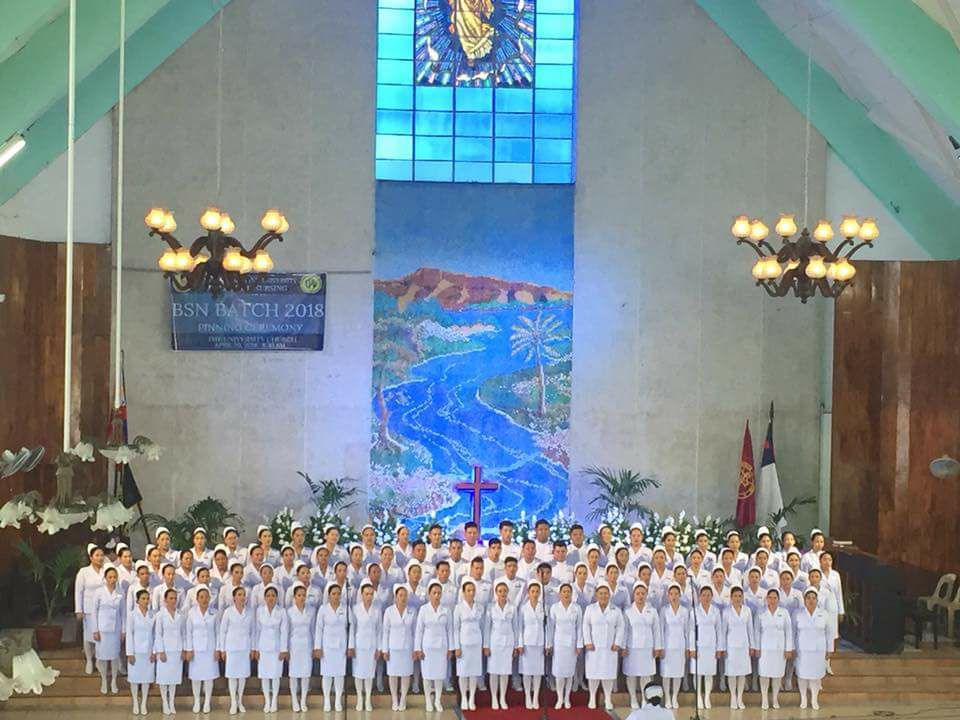
The processional started at 8:30 AM. Rev. Roger T. Quimpo, Associate Pastor for Outreach, University Church, led the invocation. On behalf of the university President, Dr. Teodoro C. Robles, Vice President for Academic Affairs, Dr. Irving Domingo L. Rio gave the welcome remarks. He congratulated the students and parents for pushing through the difficulties in school. He also encouraged the graduating students to pursue their careers in nursing. He reminded them of how fortunate they were to have finished their nursing courses from CPU.
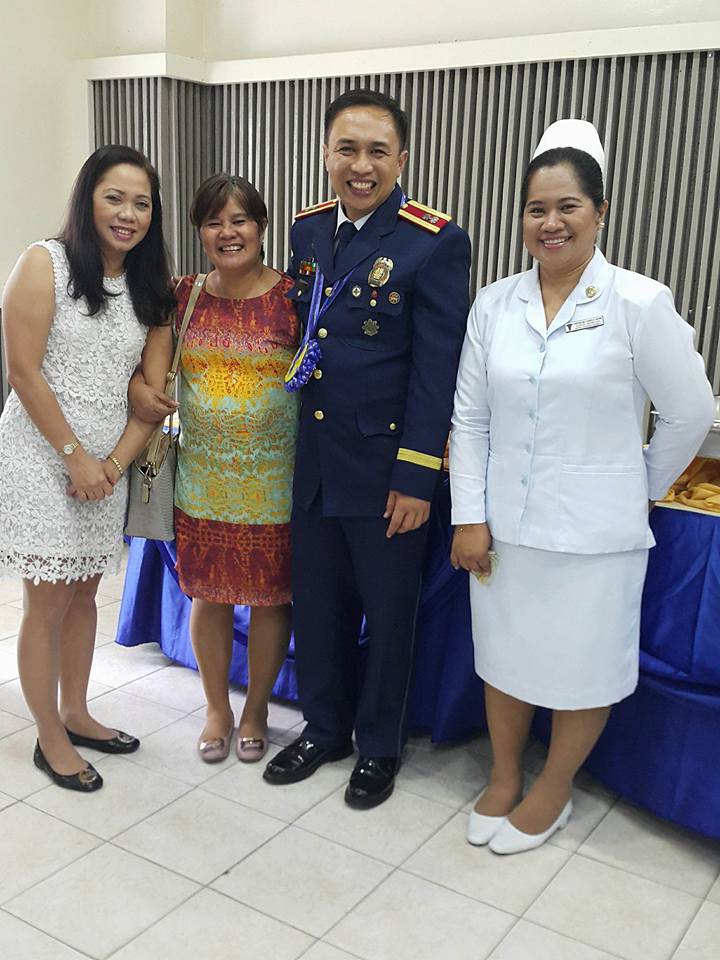
Charlie D. Baldon, Graduate Program Coordinator, introduced the guest speaker, Police Senior Superintendent Lemuel P. Nalangan. S/Supt. Nalangan described his life as “a matter of choice” long after 24 years of graduating from the CPU College of Nursing. He was a graduate of CPU BSN Class of 1994. He is currently Chief of Health Care Plans and Activities at the Philippine National Police, National Headquarters.
Police Senior Superintendent Lemuel P. Nalangan. S/Supt. Nalangan with the faculty and staff of the College of Nursing.
Nalangan recalled his memorable times in CPU and how he was prepared for the nursing career. He thanked his teachers and the school administrators during his college days. “I trusted in the education that CPU had given me.”
Although he believes that as a Centralian nurse, he should care for his patients as if they were family, he also recounted his dark experience in relation to his job with the PNP. “While my heart was to care for people, going along with soldiers at war in Mindanao was nightmare. But those experiences and trainings in combat were something that tempered my spirit, my heart, and made me strong physically, intellectually and emotionally.”
He expressed admiration to the graduating nursing students, and wished them all the good things to come in the future.
Joelah V. Rio, Academic Coordinator, led the recitation of International Code of Ethics for Nurses. The Scholarships and Awards were presented by Nelida L. Lamasan, Chairperson, Scholarships and Awards. Luke John L. Panaguiton, Governor, AHS Student Council 2017-2018 gave his response on behalf of the students.
The BSN Batch 2018 next sang their Class Song, “We’ll Make It Through,” followed by the benediction by Rev. Quimpo.
CPU President, Dr. Teodoro C. Robles and Mrs. Sabine P. Claudio, Executive Director, Camelion Association, Inc. signed a Memorandum of Understanding witnessed by CPU Vice President for Student Affairs Rev. Joniel Howard H. Gico and Camelion Advocacy Coordinator Ms. Japhet Grace J. Moleta.
In 1962 the United Nations General Assembly secured a report on the role of women in development. It resulted to a liberal paradigm of women in development and later involved Gender and Development in society, mostly concerned with equity and empowerment.
On April 3, 2018, Dr. Teodoro C. Robles, CPU President and Mrs. Sabine P. Claudio, Executive Director, CAMELEON Association, Inc., signed a Memorandum of Understanding at the Knowledge for Development Center, Henry Luce III Library, CPU. The MOU Signing was witnessed by CPU Vice President for Student Affairs, Rev. Joniel Howard H. Gico and CAMELEON Advocacy Coordinator, Ms. Japhet Grace J. Moleta.
The Memorandum of Understanding sealed a commitment between the two signatories that, among others, a partnership has been formed “to promote Gender and Development Security; to support and help one another push for equality and welfare programs for women and children.” Behind it is a CHED memorandum to Universities and Colleges putting Gender and Development as a mainstream program in their curriculum.
CPU President, Dr. Teodoro C. Robles and Mrs. Sabine P. Claudio, Executive Director, Camelion Association, Inc. with the CPU faculty and staff.
According to their Facebook profile, “CAMELEON Association, Inc. is a non-stock, non-profit, non-government organization that provides protection and rehabilitation services to sexually abused young girl-survivors in Western Visayas. Likewise, the association provides educational assistance and livelihood opportunities to economically disadvantaged children and their families in the neighboring communities through its Community Development Program. It has also established its advocacy program to raise awareness on child’s rights and prevention of any child abuse cases.” They inspire these victims to go beyond their limits so they can reach their dreams and have better lives. Most of these girls now are studying at CPU. CAMELEON was founded by Laurence Ligier, a recipient of the Legion d’Honneur, the highest French National Award given by French President Francois Hollande.
CPU President, Dr. Teodoro C. Robles expressed his message of support to the welfare of women.
Dr. Robles, in his message of support during the signing program, encouraged everyone to help and to do more for the welfare of women survivors in society. “There+s more to do to address the issues among children,” stressed Dr. Robles. Mrs. Claudio expressed gratitude for Central Philippine University, as she promised to push for more beneficial activities and projects for Gender and Development.
A special office for Gender and Development (GAD) Project in CPU is located at the Ground Floor of Henry Luce III Library. The CPU Focal Person in Charge of the Office is Pastor Ruth A. Tamonan
Dr. Rex D. Drilon, Central Philippine University’s first Filipino President.
Dr. Rex Divinagracia Drilon was born in Dumangas, Iloilo, on April 21, 1905. He spent the greater part of his childhood in his hometown where he also received his early education. He finished his secondary education and Associate in Art (pre-Law), with honors, at Central Philippine College, Iloilo City in 1925 and 1927 respectively.
Through a scholarship, he was able to study abroad. He obtained his Bachelor of Arts (English) at Linfield College, McMinnville, Oregon in 1931 and a Bachelor’s degree in Journalism and Master of Arts (Editorial Writing) degree at the University of Missouri in 1937. He was officially approved as matriculated candidate for the Doctor of Philosophy (Ph.D.) degree at Columbia University in 1949. In 1967, Prof. Drilon was conferred the degree Doctor of Humane Letters (L.H.D.), honoris causa, by Linfield College, his Alma Mater.
Dr. Drilon was a high school teacher in English from 1927 to 1929. Abroad in 1936, after graduation, he taught Editorial Writing at the University of Missouri, School of Journalism for one semester. When he came back to the Philippines, he became an English instructor at Central Philippine College in 1938-1939 and, later, a professor of English at the National Teachers College and Lacson College (Manila) in 1939 up to the outbreak of World War II in December 1941. In 1941, he was professor-lecturer of Know-Your-Philippines-Tours, Inc., teaching freshmen English, Composition and Rhetoric and Journalism, and adviser of the Manila Chapter of CPC Alumni Association. In 1960, aside from being designated as the assistant professor of Political Science, he was also the acting secretary to the President of the University of the Philippines.
As a writer, he served various positions exercising his God-given talent, such as editor, Filipino Pilgrim Magazine, Delano California (1932-33); editor, Filipino Students’ Bulletin, New York city (1936); editorial writer, Columbia Missourian (1936-1937); staff, Manila Daily Bulletin (1941); and co-editor, Teachers’ College Journal.
During the war, Prof. Drilon was an officer of the Panay Guerilla Movement. After the war, he resumed his academic work as a faculty in Central Philippine College and on one of his messages, he prophetically declared, “Out of the ruins and ashes of war shall rise a greater Central!” In response, Centralians declared, “We shall show the generations coming after us that no war of man or machine can destroy the Central Spirit and that, like a river forever seeking the ocean, the College must go on… no matter what the difficulties… The martyrs did not die in vain at Hopevale, for we now keep the torch of their vision burning…We must all keep that faith.”
In 1946-1948, he was designated dean of the College of Arts and Sciences; head of the Departments of English, Journalism and Philosophy; director of Summer School; and adviser of the Central Echo Staff. It was in this period that his students would lovingly remember him as “a journalist from Missouri who walks with a busy man’s heavy tread, keeps a thesaurus in his head, and exhibits a mood as stable as the waves, and does not want to be called ‘Resurreccion.’” In 1952-1953, he continued to be a member of the faculty teaching English, Political Science, Philosophy and Sociology and staff-editor of the Alumni Newsletter.
From 1952-1955, he was elected executive secretary of the CPU Alumni Association. He was appointed director of Summer School in 1953, and officer of Public Relations in 1954-56. In the school year 1955-1956, he was designated professor of Political Science. His career in CPU reached its peak when he was appointed as its President in June 1, 1966. During his presidency, he also served as acting dean of the College of Theology in 1968.
On June 1, 1966, President Rex D. Drilon signed the contract, making him the first Filipino President for the 61-year-old Central Philippine University. That historical moment was witnessed by members of the Administrative Staff and Board of Trustees. His installation into office on April 21, 1967 was administered by then Philippine President, Ferdinand E. Marcos. A 50-voiced choir sang “This Nation Will Be Great Again” with lyrics written by Rex Drilon himself and music composed by Frederick E. Bieler.
During his presidency, on Christmas day, December 25, 1969, the entire university property—land, buildings, and equipment—was turned over by the American Baptist Foreign Mission Society (ABFMS) to the Filipino Corporation of Central Philippine University. “This was the largest real estate transfer in the history of ABFMS… The deed of donation earned for itself the distinction of being an event without parallel in the history of religious foreign missions. The ABMFS is the first such religious foreign mission to award Filipino title to its properties in the Philippines.”
“A great Central” was the vision of Rex D. Drilon, his all-consuming passion. When he became President in 1966, it was a turn of a new era characterized by political and social unrest throughout the land. Despite all the tumult, he nourished his vision and held it high as light in the darkness, urging the Board of Trustees, faculty, students, alumni, and friends with the imperative, “We shall move this school as it has never been moved before. Central will be great.” Rex Drilon brought to the Presidency an unparalleled combined acumen of an educator, administrator, and humanitarian. He was a topflight journalist and political scientist with very strong libertarian and nationalist fervor. He accepted the prestigious yet difficult position prepared with a wealth of administrative experience gained from the places of responsibility he occupied in Central Philippine College and in the University of the Philippines.
President Drilon took to his task keenly aware of the role his administration had to play: that of a bridge between the years of American leadership and support since the founding of the school in 1905 and the unknown future. He very well knew that the success or failure of the university would be his responsibility and that of his Filipino colleagues. In his inaugural address, he appealed for support. In conclusion he said, “If your Filipino president fails, then the Filipino name is marked forever. But if your Filipino president succeeds with your help, with your loyalty, then the Filipino name shall be honored—you honor yourselves.”
A staunch advocate of academic freedom, he organized the University Forum where students and faculty could experience what he termed “a free market of ideas.” He allowed students to speak their minds with “no holds barred” and encouraged the students to write and express themselves in the Central Echo on university policies and student problems as well as on problems of the local and national governments. He was a humanitarian of the highest water, a champion of the less privileged and the underdog, but a thorn in the flesh of the arrogant and the sanctimonious and those who would betray the Central Spirit. In Scientia et Fides, The Story of Central Philippine University by Nelson and Herradura, Rex Drilon is dubbed the “epitome of the Central Spirit.”
Dr. Rex D. Drilon died a sudden death in the morning of February 21, 1971. Loved and mourned by thousands, he was brought to his final resting place at the Evangelical Garden by a procession of thousands of students, faculty and staff, friends, and admirers—seen as one of the longest ever witnessed in Jaro.
President Drilon is survived by his wife, Independencia Quimpo, and children: Ed Nathan, Lincoln Rex, and Pearl Dency.
As a final tribute to their first Filipino president, the university bestowed upon Dr. Rex Drilon the Distinguished Service Award, which was presented to Mrs. Independencia Q. Drilon during the 1971 Commencement Exercises. On March 22, 2002, CPU also bestowed a Posthumous Service Award for his faithful and dedicated service.
Rex D. Drilon is remembered in the history of Central Philippine University as the fulfillment of the dream of his predecessors—the Filipinization of administrative leadership. He is cherished in the hearts of thousands he touched with his compassionate life—students, faculty, colleagues, and friends, and, most especially, janitors and laborers for whom he had a soft spot in his heart.



 cpu articles